

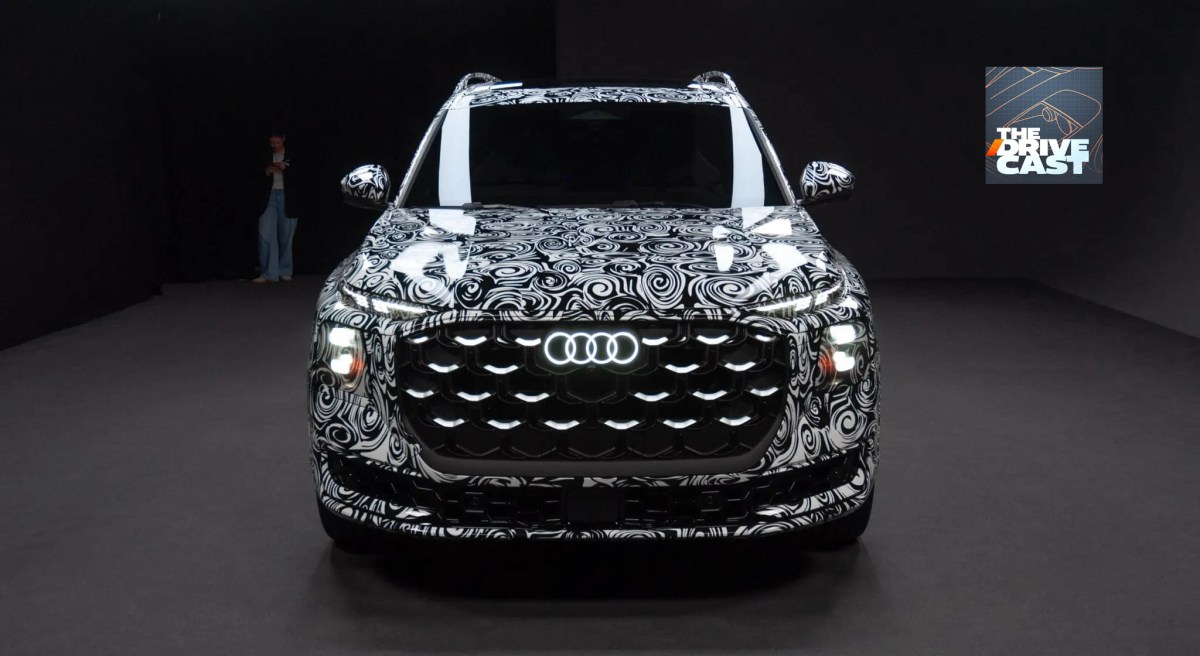
America’s roads are finally getting modern headlight technology that the rest of the world has had for over a decade. A few automakers, including, Tesla and Rivian, have dipped their toes into the adaptive lighting waters in recent years. Now legacy automakers are bringing the advanced lighting technology to the U.S. market.
With the debut of the 2027 Audi Q7 and Q9, both of which will arrive in U.S. dealers later this year, the automaker will be bringing its new digital Matrix LED adaptive lighting system to America for the first time. On the latest episode of The Drivecast, Head of Exterior Lighting for Audi AG Michael Kruppa and vehicle lighting and regulation subject matter expert Daniel Stern, who serves as chief editor of Driving Vision News a global lighting industry technical journal of record, break down what the new lighting tech coming to America means, what took so long, and the differences in how automakers are implementing the lighting systems.
The U.S. is laughably behind the rest of the world when it comes to headlight technology. It’s not because the technology didn’t exist, but rather because outdated U.S. laws have prevented automakers from bringing these modern technological marvels to U.S. roads. Until now.
Back in 2021, a lifetime ago, the government finally got its act together and brought U.S. headlight regulations and laws into the modern era via the Infrastructure Investments and Jobs Act, also known as H.R. 3684.
Enthusiasts have been clamoring for modern headlights for years. It’s the same story for safety advocates. And now, the time has come.
First time here? The Drivecast is The Drive‘s weekly podcast that takes you behind-the-scenes on the largest controversies, stories, and characters shaping the automotive industry along with the way our roads look today. Powered by The Drive‘s inside access, original reporting, exclusives, and insights, The Drivecast aims to make everyone an insider.
Listen to The Drivecast via Spotify, Apple Podcasts, or Amazon Music. Love it? Like it? Want to help? Leave a five-star review on your platform of choice to help get The Drivecast in front of more people. Have a suggestion, tip, request, or feedback? Drop us a line at [email protected]. I promise, we read every single email.
Full Transcript
Joel: All right, everyone, we’re here in Munich, Germany today with a super special episode. We’re talking to Michael, who is at Audi. He’s a doctor, and he’s Head of Lighting and Exterior Lighting for Audi—all of Audi. We’re going to talk about modern lighting, laws, and how all of a sudden we’re about to get modern lighting. We’re about to be in the modern age finally in America. Europe has been there for years, correct?
Michael: Absolutely.
Joel: We’re about to catch up over here in America.
Michael: Yeah, that’s the task.
Joel: Give us a little background on you and how you got into lighting where you are today, so that everyone knows your background.
Michael: First of all, thank you. Nice to meet you. My background: I got a PhD in chemistry, which is a little crazy to work in automotive. Spent a year in San Diego for a postdoctoral fellowship, and after that, I joined Osram Opto Semiconductors in Germany. So this was my first hands-on lighting. This was around 2006. During the time, we were fighting very hard to bring solid-state lighting into automotive. We really had to convince the people that LEDs are so reliable that you really can put them in the exterior light of a car.
After several years, getting to know what Audi was doing out of that, I still loved the daytime running lights—I think it was A5, first I saw on the road. This was my biggest dream: to work for this company. I was applying in 2012, 2013, got the job possibility, and then I joined Audi years later in the lighting team. First starting in the rear, doing a lot with the digital OLED, which you also saw today, and then following step-by-step: pre-development, function development, and now ending up in front lighting.
Joel: It’s crazy to hear someone in charge of lighting talk about how with LEDs we had to convince people these are the future, we had to convince people they’re reliable. Because back in my day, I remember my first car was a 1997 Jeep Cherokee XJ, and it had the sealed-beam halogens. I removed those lights, I put in Hella housings, and then I put in PIAA bulbs so you could switch out the bulbs and all that stuff. Now we’re in an era where you can’t just change out your headlights anymore. They’re crazy expensive; headlights are $1,000 to $9,000, and they’ve got crazy active elements to them and everything.
Now we’re about to go to that next level, right? LEDs are about to look like incandescent bulbs almost. We’re about to take the next leap with OLED technology and adaptive Matrix LED headlights. So, let’s actually talk about that. One of the things before we get into the new technology itself, let’s talk about laws and how we got here. America is behind in so many ways, of course, as people know on the podcast. But in lighting specifically, we are behind Europe and the rest of the world in many ways.
The rest of the world has what’s called matrix lighting. They’ve actually had laser lights. They’ve had so many advances that we missed out on because of our outdated 1980s-era regulations. That just changed recently—we’ve done many stories about this. Back in 2022, the laws changed. But as people that listen to this podcast know, cars aren’t developed in a year or two, right? So if a law changes in 2022, it takes years for someone to develop, even at a rapid pace, to get modern lighting over to America and meet regulations. Can you talk to us a little bit why we had the old laws and what changed to enable us to get modern lighting?
Michael: I think your description is absolutely right, but also the rest of the world is still a challenge to talk through authorities and regulation. What are the new possibilities solid-state lighting is bringing? The LED is something people had to get to know. They had to learn what are the possibilities, what to do. Step-by-step, we were increasing the functionality. It’s not only light on, light off. As soon as you go to smaller light elements, which the LEDs are, you can really create crazy things like light patterns. You can create arrays which are creating light distribution in total. By this, you can do things contributing mainly or massively to safety, especially safety at night. This is what we have to keep the focus on.
The other thing is, you see it also in your private life, light is getting everywhere. You use light for decorative elements, and this is really what we have to avoid. Because we don’t want to be a disco ball on wheels. We have to do something that is helping you to travel safe at night. This is also, to my understanding, what the regulation is really focusing on. Even understanding the possibilities, they’re going in small steps in the direction to avoid overflowing traffic with light which you don’t need.
This is exactly what we’re also experiencing in the U.S. In the end, something everybody has experienced while driving at night is glaring. I think everybody knows if you have a situation where you have a lot of light coming against you, you don’t feel safe anymore. You feel offended, you feel maybe dangerous, you don’t know whether you’re doing the right things, and this has to be avoided. This also has to be respected. This is, from our understanding, also what the regulation in the U.S. is trying to do: to go in small steps to understand what you can do good, but also to understand where you are in the dangerous area where you do too much. This is something we have to regulate.
The good thing is starting in Europe, in the end, we could prove that this has a contribution. With the regulation of matrix lighting in the European market, we were able to show, also with European cars to the U.S. authorities, what is really the benefit of an autonomous driving headlamp beam. Really getting the feeling that you don’t have to pull the trigger to deactivate your high beam; the car is doing this autonomously. Even if you’re lazy and not doing that, or you forget it or something like this, the car is taking care and is avoiding that the car coming against you is being glared by you driving in an Audi which has lovely light in front of you. You feel safe, you have all the light on the road you need, but the person coming against you says, “Oh no, this is an Audi, this is what we have to avoid for any cost.”
In combination with that: understanding a system, possibilities versus what is allowed or what is not allowed. Within a dialogue, you have to understand what are the fears or what the people are afraid of, and trying to really contribute to safety. Not only loving the technology and putting it in the car because you can do that, but really understanding what is your contribution to safety at night. This is what is continuing, what has been done many years in the past. Really understanding, our colleagues from Audi of America and everybody, what is the possibility to do.
Joel: I think you actually hit the nail on the head there for a second. A couple things: one, the thing you mentioned is safety, and I want to get into that; two, light pollution; and three, blinding people. One of the problems that I hear from so many people—we’ll go in a couple different orders here—one of the problems I hear from so many people is, “Oh my gosh, that car’s got LED lights,” because in America that’s like the technological marvel at the moment, “LED headlights, and oh, it’s blinding me! The headlights are too high!”
What a lot of people don’t understand is that modern headlights, specifically in a lot of higher-end cars, have auto-leveling systems, right? So when the car is loaded down, the headlights will go down; when the car is unloaded, the headlights go up. I think that’s a thing of the past, right? After the XJ, I had a WJ, a second-gen Grand Cherokee, and I put in bright, bright lights and HIDs. What I would do is I’d raise them up until I started getting flashed by people, and then I would go, “Oh, I’m too high,” so then I would lower them down. But all that was mechanical; I had to turn a screwdriver or whatever.
Now, dealerships, this is all electronic, and it’s all levels and all that stuff. People just need to understand that people are scared of the technology because it’s very advanced. To your point earlier about the disco ball, I think that that is what consumers believe automakers are trying to do: make this a rolling disco ball. So I’d like to dive into that safety element, right? Because we’re on a podcast, we’re talking visually, people can’t see what we’re talking about, but describing a little about some of these safety elements that can be had with OLEDs and even LEDs, and the matrix lights that are coming to America—to explain these safety elements and why these advanced headlights enhance safety would be great for people to understand.
Michael: Sure. So starting in the front with the LED: once more, the LED itself as a lighting technology is not intrinsically glaring people. It’s just about leveling. So in the end, if you build in the lamps properly, you have it in the right trim link, everything is fine. So it’s not that switching from halogen to LED automatically blinding is taken care of.
The second thing is what you always have to take care of—also small details—you have to have a clean headlamp. If you have any contamination, light will be scattered. This is nothing you can avoid from the light source itself; this is something you can contribute yourself, taking care of your car.
The good thing about the LED is the light color. In the end, what we can do, we can really simulate daytime from how white the light is. Some of you might have the feeling with older cars, you have a little yellowish light or something like that, or it seems like to be not really bright because it seems to be very dimmed. All of this in combination is helping your eyes because you’re using the right color point and simulate daytime. This is helping your eyes because your eyes are receiving blue light, which also activates you being more awake, being more aware. All of these small contributing points are coming hand-in-hand with an LED.
The second thing is how light is being distributed on the road. Just putting light straight in front of you is not helping you. It’s a question of: is it only on the road, or do you get a little bit left and right? This is what we name “field of view,” so that you’re not running down a road with a very narrow sight only on the street; you also would like to see a little bit what is happening next to the road.
Joel: Like the ditches, so that if a deer was coming in the ditch…
Michael: Exactly, wild animals approaching. So you would appreciate to see them 1 second or 0.5 seconds earlier before it’s on the road, so you’re able to hit the brake and avoid any kind of car accident. So this is now the possibilities we have with the LED in front lighting.
If it comes to the rear, like our digital OLED for example: first of all, the rear is not projecting light on the road; you have light on the car. In the end, what you don’t want to have is to have a lot of light blinding you when you’re driving behind that. We would like to have a very homogeneous distribution on the trunk, on the rear of the car, and also it must be very simple in understanding what it is.
Just giving you one example: if the turn indicator is too close to any other, let’s say, brake light for example, you might have some irritation—is the turn indicator on or is a brake light being used? If it comes to the tail lighting you’re driving, you want to see what is the width of the car. Coming really from coast to coast, you can really get an estimation: the car is big, the car is small, what is your distance? All of this is helping you to be pre-alerted on the traffic situation you’re approaching.
I think this is what everybody is experiencing at night. You want to have a clear vision what is happening in front of you, because it’s dark outside, you don’t know what’s happening from the unknown left and right and so on, and all of this in combination is helping to create safety. From digital light sources in the rear—and this is what we’re also doing now in the Q7 and Q9—we start to put in some communication content. What we can now do is to explain a little bit more if a light is changing, what’s the meaning of that.
I think all of you learned red light means something is in front of you. Even brighter red light means the item in front of you is getting slower, so this is something you learned. Now if you’re putting, for example, like our communication lighting, you get information: “Hey, there might be a tricky situation in front of us.” Or the proximity indication which we have, if you’re approaching the car, all the OLEDs are being turned on, which you can also experience on the Q7. This is giving you a first car-to-X communication possibility, understanding, “Hey, the car would like to give me some information I did not have before.” More red light means maybe to back up a little bit and see what’s happening, so to be pre-alerted.
This is our philosophy. At the moment, you hit the brake, you see the brake light, the only thing you have is reacting on that. What we would like to change is be proactive, so getting information before something dangerous is happening. This is our philosophy which we would like to continue doing in our lamps.
Joel: So then—and I think that that is helpful context of reactive versus proactive, right? I think in America, Rivian is one of the first automakers in America at the moment—and I think it was a timing thing, the timing of this vehicle, the generation two R1S and R1T came out for model year 2024, if I remember correctly, and 2022 was the regulation change. So once those regulations changed, they were able to adapt their lighting to have Matrix LED headlights in America rapidly. That was a timeline thing.
I’ve driven a Rivian, I don’t know if you have, and the lighting is very active in the front. You’re going down the road—and to be clear for those listening, it’s active for the driver. So if you’re coming at me, you don’t see it being crazy active, you’re just never getting blinded. But as the driver, to your point earlier about the ditches, it’s almost like I’m driving with my high beams on at all times, which I’m not, but it acts like it. Then as another car comes at me, it kind of adapts the lighting to be the low beams, but only around that car, right? So this is the best explanation I can do to someone who’s not seeing it visually.
They’re hyperactive. I would call them hyperactive. They are constantly moving, it’s dazzling, it’s a wow factor. Obviously, I haven’t experienced yours yet when we’re recording this, but can you talk a little about your guys’ philosophy in terms of how active the lighting is and how it’s moving and dancing in the world versus that kind of system?
Michael: In the end, I think a very important point: adaptive driving beam. This is really something you have to rely on the system if you activate it, that you’re not glaring anybody. By this, you have to respect regulation. This is the special task the U.S. government or regulation gave us: that the U.S. requirements are different from the rest of the world. We have many, many years of experience. We started with this technology in 2013. We had our first A8 on the market where we really showed that this is something really contributing to safety, and we learned a lot.
In the way you’re applying this kind of active regulation—of the light on, light off—you can really create something which is a little hectic or a little smooth. You can play with dimming ramps, you can make it get a huge distance from the car so that you’re not running to also, if you’re following a car, you put a lot of light in the trunk, in the back mirror, where you don’t want to have that. By this, you really can apply this technology differently. This is what we experience also looking to other cars in the market in Europe or the rest of the world. Every company has a little bit of a different philosophy.
We at Audi, we are focusing so much on that you really get a smooth impression on what’s happening. For example, in Europe, it’s starting with that if you activate the system, it’s like a theater curtain opening. Even if you don’t understand how it’s working, you get the feeling, “Okay, now the complete system is active, some kind of intelligence is helping you to travel safe through the night.” By that, of course, the camera system is detecting where is the car coming against you. With this information, you can now play around with different car segments—I will show you later in a presentation—different elements which can be activated or deactivated.
Now with the new technology that we are running, our Digital Matrix LED light—not all our competitors are using that at the moment—you can really get even closer and really fill up areas where you’re losing light if you’re going too far away of the system. Because this is our promise: we want to give you the best light feasible in the market you’re driving in. We don’t want to cut away light so that you just have the matrix feeling and you’re missing 50% of your headlamp because then it’s no high beam anymore.
This is the Audi philosophy: to really provide light when you don’t have the active system, meaning low beam, fulfilling other regulations which we are also seeing to whatever safety picks or whatever we are talking in addition to really have a good system, not only fulfilling everything for the high beam. If you have the high beam on, you must be clear you’re never glaring anybody. The application doing that, the software which you’re putting inside, the camera system which is inside, we are convinced the Audi system is superior to what we see from our competitors, because the application is really going not to jump in and jump out, to really be more smooth following what’s happening, so you can really see how the light tunnel is working so that you really have the tunnel and the car in front of you is not being glared.
Joel: So the two things I just heard, the differentiators—correct me if I’m wrong, but the way I just interpreted it—was, one, yours is more of a, the keywords I heard were “smooth” and kind of like an opera or show where it’s like a curtain—people can’t see me, but I’m using my hands as if you’re at a show where the curtains are going open and closed, right? Whereas the Rivian system, which I’ve experienced, it’s more dancing, right?
Michael: Click-clack…
Joel: That’s a good—I would agree. Click-clack, it’s dancing stars and little elements are moving and shaping and it’s constant, and it’s amazing and incredible to watch because it seems like a marvel of technology to think of when I was a kid, the halogen lights that were yellow, to your point, in a snowstorm, and this is just dancing all over the road. It’s crazy.
But I would not call that system elegant. I would not call it by any means an opera opening and closing of the theater. What I’m hearing from you is the reason the differentiator that enables your system and that system to be different is a higher resolution camera, or a clearer camera, more advanced camera, something about the camera?
Michael: Camera, software, application. Of course, in the end, you just can imagine you have different triggers you can activate. So you can program—I think it’s an easy way to program our systems like the Rivians are running. The question is if you want to do that. In the end, it’s the way how you apply that, and this is I think every car brand is doing this a little bit different. How fast you’re turning it on, how fast you’re turning it off, how close you want to get to a car, all fulfilling regulation.
Our philosophy is really that this kind of experience is the same in every car in the future. I mentioned in Europe we have this system really from an A3 up to an A8. Our philosophy: you as an Audi customer, you’re getting the same matrix impression or experience from the small car to the higher cars. This is some kind like a fingerprint. We are not so much into the click-clack because we think if you’re traveling a long time, this might be a little bit of annoying because it’s too much happening in front of you. In the end, you can see how the system is working, and this might be quite a nice impression in the first instance, but if you’re doing this for one hour, everything is jumping the whole time. But this is also something which is giving you a personal flavor, so in the end you might be a favor of the one system or the other because you want to be really into the system to see it. Our philosophy is more to really have a premium impression that all of these systems are working very smooth to each other, and this is the way we are doing that.
Joel: Fair enough. For people, a bunch of family members of my family orbit have current cars that theoretically the hardware have matrix lighting and laser lights and all this cool stuff that Europe has, and in America it’s not—it didn’t, when those cars were sold, it did not pass regulations, and so it’s turned off in air quotes for America. For anyone that’s listening to this that might have a vehicle like that, would it be something that Audi is capable of doing for an over-the-air or even a dealer-installed software update to enable this for America, or is the hardware in these new cars that have this coming to America different enough that we can’t retrofit this, if your car has it, it’s not going to get it for America?
Michael: Unfortunately, the last point. In the end, you really have to respect this from the very first beginning you do the hardware development. Just taking the European system over and do exactly the same, even if you have the software or the camera, the hardware is not capable to distribute the light in the way to pass testing. Because this is really what you have to do. Of course, first of all, you don’t want to glare anybody. We say the European system is fine for that, but fulfilling testing and regulations in the U.S., these systems are not equipped in the way to distribute the light properly.
So you cannot just say, “Okay, now activated, you can use it.” You really have to work inside the headlamp, you really have to modify plastic parts, you have to modify the lenses of the light modules, you have to modify the light distribution of those lenses, and this is just something we cannot do over the air. Unfortunately, you have to wait for all the new cars coming, because this is our philosophy to continue now the story starting with the Q7 and Q9. So this is now, we have this technology on hands, and our vision is to really bring matrix to everybody on this world.
Joel: Just to be clear, I heard it’s not that it wouldn’t work in America. To your earlier point when we started recording earlier, it’s a difference in market regulation, right? The headlights in someone’s Q8 today that have matrix technically as far as hardware and the laser lights, it’s not that they wouldn’t work in America, but they were designed and developed for Europe, and they just were disabled for America because they don’t meet our regulations. To enable them in America, it’s not that they wouldn’t work, they wouldn’t meet our regulations because of market differences, correct?
Michael: That’s absolutely right. The system will be functional, you get all the information you need to operate it properly, but if you put these cars on a test track or test drive to fulfill U.S. regulation, you will fail. This is clear, and that’s the reason also why it took some time for us to develop those systems to really fulfill everything we’re demanding in regulation, but also our promise. It’s not only fulfilling regulation, it’s also an Audi light which is premium impression for you behind the steering wheel. You get the premium light distribution on the road fulfilling all these regulations. This is why we are convinced it’s not only fulfilling regulation, it’s also our philosophy how we would like to bring light to our customers.
Joel: Talk to me a little about regulations in America versus China versus Germany. Obviously, these are different markets, they have different road conditions, they have different market conditions, different driving dynamics, and all these things. A lot of people talk about whether it’s safety crash tests or design or lighting, that it’s really frustrating that this country or that country gets this cool technology and we don’t. Arguably, America is behind in many things, specifically when it comes to automotive, and it’s all regulations because they haven’t been addressed for the modern era. Headlights is a great example of that, of course. Our headlight technology and our laws were back in the ’80s, and now all of a sudden in 2022 they finally were addressed. Can you speak a little as an automaker to: would it be more convenient, or would it be just as complicated for different reasons, if the world had one global standard for lighting and all that?
Michael: To be frank with you, I would like to develop one world headlamp. This is, of course, the ideal situation, and if not, I have to think about how can I respect local demand. But in the end, this is also our philosophy. What we are now doing with the Digital Matrix lighting is we put digital content inside, and digital means I can change it by software. This is our vision to go.
First of all, showing to, of course, authorities what can be contributed good. I’m totally respecting that there will be small steps to accept new technology, but I think you have to be open-minded to really see what is the feeling on the road, how do you really contribute to safety. By this, I think we are still not finished. We are continuously showing this to authorities to really give them a first hands-on. We talk to them, we also listen to them to understand, “Okay, why it is like it is?”
With the new technology development, I think we can more contribute exactly to the questions which we are getting. In the end, whether we are really successful to have from China to the U.S. to Scandinavia or to Africa, everything in a homogeneous way, I don’t know. I dare, because I think there will be different road conditions, there will be different day or nighttime conditions, it will be snow or sandstorms or whatever it is. But just imagine a future where you can contribute exactly the demand of the driver coming from one light source, understanding what’s happening. This is our vision: to really analyze what’s happening around you and giving you the best light which can be contributed.
Joel: Hey, I really appreciate the time. Thank you so much for coming on the podcast, this was a lot of fun. Modern lights, we’re entering a new era, and it’s aimed in terms of an automaker in terms of safety. I really appreciate the time, thank you so much.
Michael: Safe traveling, especially at night.
Joel: All right, now we are joined with someone who I think is especially exciting because I am a lighting nerd, but Mr. Daniel Stern, who’s a vehicle lighting and regulation subject matter expert, and he also serves as the Chief Editor of Driving Vision News, a global lighting technical industry journal. That means this man consults for everyone from automakers to the Canadian government because the man knows lighting. Daniel, welcome, thank you for coming.
Daniel: Thanks for having me.
Joel: So, I know that you’ve heard what Mr. Kruppa said about the Audi lighting Matrix LED system. You obviously know a lot about Matrix LED lighting systems and headlights in general. I’ve experienced a bunch of these. I want to just, as broad strokes for people: why has it taken so long for America to get what I would consider modern headlights, when the rest of the world have had these things for a decade or more?
Daniel: Well, basically because the United States does not follow the same regulatory structure as the entire rest of the world. The U.S. alone…
Joel: Boy, it sounds like every other part of the cars! Like every other part of the cars.
Daniel: Pretty much. We live on a regulatory island. The rest of the world uses the UN safety standards, and the U.S. devises its own. They’re structurally very different.
Joel: Kruppa actually said something during all that that alludes to this, and he was like, “Boy, it would be really easy if everyone just used the same headlight standard, if we had one headlight for the whole world.” That is something that Kruppa said.
Daniel: He’s right about that, and in fact, there’s really good quality research from years ago showing that there’s really no justification for different regulations in the United States, because—this is kind of fascinating to me—because the differences in road conditions and amount of alcohol consumed and number of bicycles on the road and all these other parameters that could matter to something like this vary more state-to-state than they do between the U.S. and Canada and Australia and Germany and Japan and all the other countries they looked at. There’s more variation within the U.S. than there is between the U.S. and these other countries, so there’s really no justification for the U.S.—no safety-related justification for the U.S. to have its own special, different regulations. But the U.S. moves slowly, and the regulatory wheels grind especially slowly, and yeah, so that’s why it took so long.
Joel: It’s funny because what I just heard is, we’re all people, and yet we need to be different. God bless America. So, I want to tap your mind. Audi and Rivian—Rivian was one of the first in the US to get Matrix LED headlights on the road, that was for model year ’25 with a very mild refresh externally, very extensive refresh internally under the metal skin. Now Audi’s about to be one of the second automakers or early automakers as well to bring them at the end of the year, this year, in the Q7 and new Q9.
Kruppa and I talked about this, and you obviously heard this, there’s variations in how these automakers are doing it. Audi is going to be more like an opera curtain opening and closing, it’s a very soft transition. I’ve experienced both these systems, and I would call it fluid. Rivian, their setup is much more like a tap dancing, it’s a constant light show adapting as you go, here and there and everywhere. So I’m curious about your take on the different automakers doing it in different ways. Even though we’re using the same technology, their implementations are different.
Daniel: Well, and we’re not even using the same technology. There are a lot of ways to do this. There’s a huge number, and companies, suppliers have been enormously innovative. There are scanning systems, raster scanning systems, and there are spinning mirrors, and there are micro—there are MEMS devices. There’s just all kinds of ways to do it, all kinds of optical techniques and different ways of putting the light source and everything, lots of ways to do it.
You mentioned the difference between the sort of dancing light effect in a Rivian versus the much more, much smoother, sort of much more subtle appearing effect in an Audi, and yeah, that’s absolutely a thing. Which way’s better? My vote would probably go for the Audi approach because I really don’t want to be distracted by dancing light. But we’re at a stage in this, particularly on this continent because it’s so new here, that it’s—you know, maybe you’ve heard the expression “lighting is the new chrome.” We’re kind of doing with lights what we did in the 1950s with tail fins and, yeah, chrome. You know, “Whee, look what we can do!” So I think there’s some element of that in systems that really sort of put it in your face, “Look how this light moves around, isn’t this cool?” But I think once the novelty wears off, I’d really rather have something more like the Audi system.
Joel: That’s fair, and I would say I don’t know which I’d rather have, having experienced various situations in both these cars. I’d say they’re very different. They’re very different. The Audi system is, it just kind of fades into the background—this is going to support your argument, by the way—whereas the Rivian system, it is an ooh-and-ah show. It is an ooh-and-ah show.
That said, I also acknowledge the fact that I’m getting in and out of these cars, whether it’s hours, days, a week at a time. I have to imagine at some level, whether it’s the Rivian, the Audi, whatever, that eventually the novelty wears off, as with all things do, and it just fades into the background and becomes part of your daily life. But again, I don’t know that because I haven’t lived with the system for months and years.
Daniel: Right, neither have I, and what I sort of go on is many years ago there was a popular Lexus model that the headlamps happened to be built such that there was a reflection off of the chrome bezel inside the headlamp. And so there was this sort of “X” of light way above the low beam pattern, and if you were driving towards a wall or if you were driving towards a road sign, you could see this “X.” It wasn’t detrimental to safety or anything, but I lost count of how many people would say, “How do I get rid of that stupid ‘X’? It’s driving me nuts!” It seems a small thing, but when you’re driving, at least it’s to be hoped you’re focusing, and anything that distracts you is, well, it’s going to distract you. But that said, yeah, I haven’t lived with the Rivian system long enough for it to become routine, maybe that does fade into the background.
Joel: TBD. So, Kruppa mentioned three different reasons that Matrix LED adaptive headlight technology is really important, and the three were safety, light pollution, and blinding people. I’d love to get your take as an expert and independent person on this topic as far as these three, and do you agree with him, is it all or nothing? Safety, light pollution, blinding people.
Daniel: Well, I think I’ll take the second point there first. It’s a little difficult—I mean, yeah, I suppose in theory maybe you have a slight bit less stray light. I think the light pollution argument is a bit of a reach. There was some activity from the Dark Sky people and I think one of the other outfits saying, “Hey, you know, headlights are getting brighter and brighter to the extent that it’s messing with wildlife,” and that’s interesting. But I’m not going to sit here and say he’s wrong, but I would love to know more about where that argument comes from because just on its face I have some difficulty with that.
As far as safety: yeah, anytime you can put more light on things and people that we would like not to hit while we’re driving, and you can do it without increasing glare, absolutely that’s going to be a win for safety. That said, an adaptive driving beam system has limitations, it’s not magic. Above a certain degree of traffic density, when there are enough cars in front of you—you’re driving a car equipped with ADB, when there are enough cars in front of you—the system can’t generate enough shadows to sort of shadow out all of these cars and still have anything left of a beam pattern, so it reverts to low beam. So in dense city traffic, that’s not going to be of a great benefit, but in lesser density, in sort of medium density traffic, absolutely it’s much better than low beam.
Low beam for a hundred and some odd years has been inadequate for the tasks that we ask of them. In order to keep glare to some kind of livable level—and even that, you know, we’re pushing the boundaries on that, there’s a lot of glare complaints lately—you just, geometrically with a low beam, you don’t have enough seeing distance for the speeds that we drive. So anything that’ll get more light further down the road to sort of accord with the speeds that we’re driving at is great, and ADB, at least in theory, resolves this century-old conflict between seeing and glare. So yeah, I’m very much on side with the safety argument.
Joel: To be clear, so am I! As you and I were talking before we recorded this, I’m a headlight nerd, and the more light the better in all situations. There is probably to an extent of being too bright—I may have done that with my Cherokee at one point, but…
Daniel: Well, yeah, I don’t agree with “the more light the better.” What’s really crucial, even more than the amount of light, is how the light is distributed. It’s better to have less light properly distributed than more light poorly distributed, and that’s why an adaptive driving beam system is so brilliant, because it’s doing a better job of directing the light where it needs to be and keeping it away from where it shouldn’t be than just a static low beam does.
Joel: So, something else Kruppa said that, of course, he would say, you would expect him to say—he works for Audi—but you don’t work for Audi, and you don’t work for Rivian, you don’t work for any automaker, you’re independent. Kruppa mentioned that he believes the Audi solution is superior because it’s not jumping around, because it’s smooth and you see the light tunnel working, but not blinding the car in front of you or the car coming towards you. He mentioned something called the “light tunnel,” and I think that’s a really important term here, based on exactly what you just said of the distribution of light and how it’s blinding people coming to you or away from you or in front of you, and that’s why he believes the Audi system is superior. Do you agree with Kruppa that certain technology or implementations might be better in terms of the quote “light tunnel” and blinding cars coming to you or away from you? He was referring to the Rivian system that we were discussing at the time.
Daniel: Well, yeah, I mean, yeah, in general, it’s always going to be the case whether we’re talking about headlamps or computers or any technology, anything, there’s the concept and then there’s the implementation. A terrific concept can be spoiled by a crummy implementation, and a terrible idea can be shored up by an amazing implementation, although that’s less common. So yeah, as they say, the devil’s in the details.
I’m not going to sit here and say, “Oh well, the Rivian system is poopy,” because it’s not. I will say that Audi have been—they made a conscious decision some years ago to put themselves at the forefront in lighting. I think it was the 2011 Detroit Auto Show, I saw enormous new lighting content on Chrysler products, and I called up their lighting lead and said, “You know, I’m not complaining, but what made this difference between last year and this year?” And he said, “Oh yeah, well, Audi, you know, we call it the Audi curse in this industry. Audi started spending money on lights, so now everybody has to spend money on lights.” Obviously that means everyone who drives at night wins.
I do think I agree on this particular point with Mr. Kruppa, that I would rather have sort of smoothly morphing tunnels than jumping ones. But to sort of narrow in on this idea of the light tunnel, so that people probably understand from your talk with Mr. Kruppa, but just for a quick review: an adaptive driving beam system dynamically shadows other drivers out of what is otherwise a high beam pattern. So it keeps track of where other people are in front of you and it shadows them out.
Here’s where the difference really gets large between the US system and the rest of the world system. The rest of the world, the philosophy is: make the tunnels as small as possible, so concentrate really on keeping the light away from driver’s eyes—maybe light up the rest of their car, but keep the light out of their eyes—and make the tunnel as dark as possible. The U.S. system says the tunnel has to be large—it actually specifies a size—and the tunnel cannot be darker than a low beam would be at whatever point the tunnel is. So if your other car happens to be situated in a place where the regular low beam would glare them, they’re still going to get glared with the U.S. ADB system because the law says it can’t dip below the intensity of a static low beam.
So I feel that’s kind of unfortunate because it really kicks one of the legs out from under ADB. ADB was supposed to free us from this conflict between seeing and glare that we’ve been stuck with for a century, and that requirement in the U.S. regulation is really unfortunate because it artificially restores this compromise between seeing and glare to a system that was meant conceptually to eliminate that.
Joel: Hmm. It’s really unfortunate that America’s coming late to the party, and then we’ve kicked out a leg that is a benefit to the modern systems. But, suppose we could say that about so many things with America and how we do things. We got to be different, to your point, Daniel, we got to be different.
Last question and then we’ll let you go, I know your time’s valuable, but we will definitely have you back on, you are beyond knowledgeable. I am curious, if you ask me, in my lifetime there have been certain moments in history where we’ve had these monumental leaps in terms of safety: seatbelts, airbags, anti-lock brakes and traction control, electronic stability control around 2000, and automatic emergency braking. These are the pillars of—every decade, half a decade, pick your timelines here—these massive leaps in safety that got democratized over time very rapidly, and cars abound had them and it really did save lives and stop crashes. Would you feel that—and I never probably would have put halogen or sealed beam or HIDs or LEDs into this category personally, but I am curious your take on adaptive lighting and whether you feel it is that monumental or it’s not as monumental in terms of safety as the things I just listed?
Daniel: I have a hard time seeing how adaptive driving beam as implemented in the United States will make that list. If for no other reason than it will be—the regulation as NHTSA has put it out and insisted on is difficult and costly to comply with, and that’s going to make it hard to democratize. There are popular price cars in Europe and the rest of the world, mass-market cars with basic but effective adaptive driving beam systems—we’re talking like Toyota Corolla-level cars, high volume, low price cars.
Joel: You don’t see that happening here.
Daniel: Not for a long time. It might, but I don’t foresee it anytime soon. I think for the foreseeable future it’s going to remain the province of really cool, really expensive cars in the United States.
Joel: For context for everyone, the cars that currently have it are the Rivian R1T and R1S, and upcoming Q7 and Q9, all of which are $60,000–$70,000+ vehicles. That said, even something like an Audi Q3, to what Daniel just said, you can get this system on an Audi Q3 and I’ve experienced it in Europe, and that is a less expensive car. So TBD on how far, but I would agree with you. A Toyota Corolla, they really democratized LED tech and put that in that car early. I don’t see that happening here with this technology that costs more than an LED headlight setup. Daniel, thank you so much for being here today, really appreciate your time. We will absolutely have you back, and just thank you for coming.
Daniel: You’re very welcome, thanks for having me on.
Read the full article here