






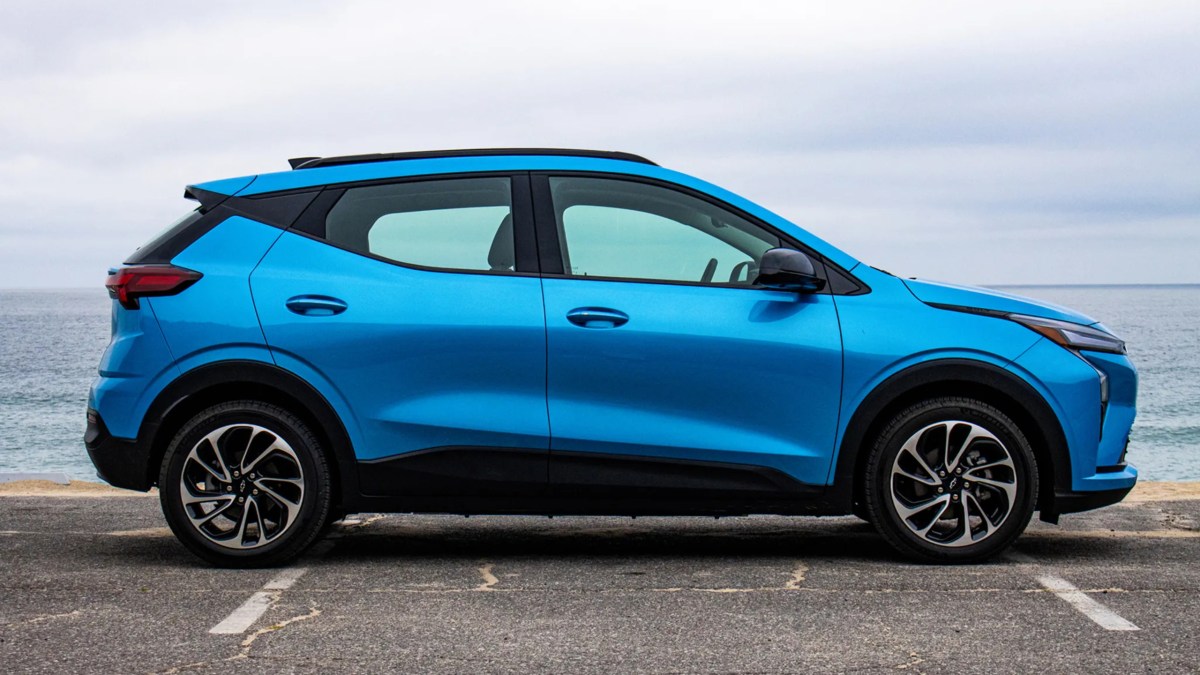
More than once, the Chevy Bolt has enjoyed the pleasure of being the most affordable EV for sale in the United States, and now we’re learning that GM aims to hold onto the Bolt’s sub-$30,000 price point for as long as the new iteration remains on sale. In an exclusive interview, we asked Bolt chief engineer Jeremy Short just how GM got the price down—and how Short’s team plans to keep it that way despite the volatile economy climate.
“It was part of our goal,” Short said of the Bolt’s affordable price. “A lot of things have gone up in price in the last five years. We’re not one of them, and it took some work. Everything else we buy goes up. Somehow I have to make cars go down. [Laughs] But I made my life decision.”
It helps that the Bolt is not expected to be around for long. For the moment, GM only plans to produce the redesigned EV for another year and a half.
“Because it’s a limited run, it’s not like we’re going to be making a bunch of changes,” Short said.
That means that GM has only a limited window in which to jack up pricing if it wants to squeeze more money from the program. But will they?
“No, we have no intention of that,” Short said.
It also helps that the new Bolt is, shall we say, conspicuously similar to the car it replaced.
“I would say the combination of time and cost was probably enabled by the previous model,” Short said.
But it wasn’t merely the recycling of old components that helped the process along. Chevy also collected a ton of feedback (not to mention raw data) from its customers, all of which helped guide its engineering and marketing teams as they spun the 2027 model up.
“In 2017, when the first one came out, we didn’t know how customers were going to use them, we didn’t know what public charging was going to look like,” Short said. “Now being on the third variant of the vehicle, we have a clearer picture of who our customer is. It’s really two customers.”
“There’s that LT value customer, and then there’s that person who wants a cost-sensible car with all the latest tech,” Short said. “That’s why we were the first Chevy and the first [GM] EV to have Super Cruise. Which is a little weird, but that’s because we had that customer that wanted all the tech. 360 camera, full display mirror, in a car that’s easiest to park. They wanted all of that.”
Short says GM also learned where its EV customers overlap with those who still prefer legacy models, providing further insight into how they might optimize the new Bolt’s packaging.
“We also have a traditional Chevy customer that’s into efficiencies and all of that, like hey, I want cloth seats. Maybe I want it heated. I don’t need it ventilated. I don’t need this, I don’t need that,” Short explained. “Their perception of it is—and they’ve given us this feedback—if you add it and you brag about it being standard, that means I’m paying for it and I don’t necessarily want it”
And lest we downplay it, Chevy did way more than simply throw the old Bolt back in the oven to reheat. For starters, the entire operation picked up and moved from Michigan to Kansas. On top of that, the subframe was re-engineered to accommodate a redesigned battery and motor, and the Bolt had to be fitted with the Tesla-style (and now-industry-standard) NACS charger.
So, if you’re eyeing a new budget EV at some point in the next 18 months, you can count on the Bolt’s base price remaining right where it is—at least if GM has anything to say about it. And with the new Bolt, which isn’t dependent on incentives to remain affordable, that should be the case for the duration, no matter how short that may be.
Got a news tip? Let us know at tips@thedrive.com!
Read the full article here


