

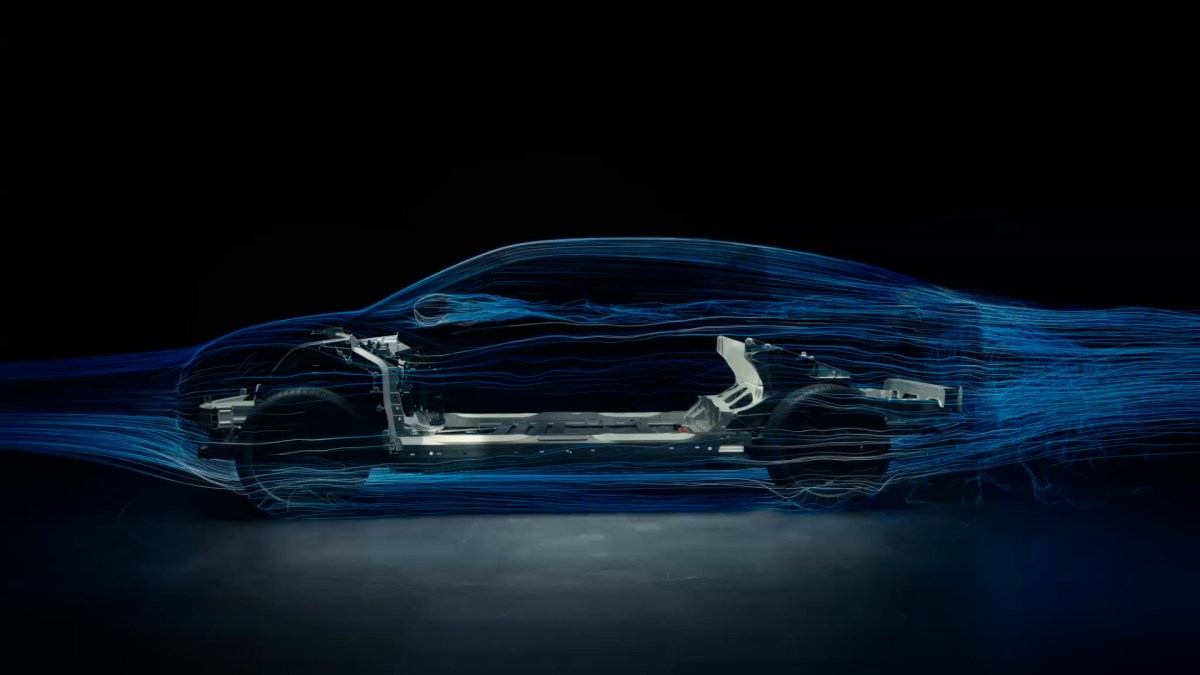
If you’ve heard it once, you’ve heard it a thousand times: Modern cars are mind-blowingly complex, packed with countless electronic modules and miles and miles of wiring harnesses. But here’s the thing: when it comes to truly groundbreaking cars, mechanical and electronic simplicity are the name of the game—and with its new EV platform, Ford is looking to level up to match (or surpass) its rivals, here and abroad.
If you’re building an EV and bragging about its many dozens of ECUs and various brains talking over, around and through each other, well, to put it in motorsports terms, you’ve already been lapped. In 2026, complexity is old and busted, and simplified zonal systems are the new hotness. That’s why Ford is so excited about its new Universal Electric Vehicle (UEV) platform.
What exactly does “old and busted” look like? Well, to keep things fair, I’ll use an example from Ford’s own portfolio: The F-150 Lightning. It’s no secret that the first-gen electric truck was fast-tracked—virtually every mainstream automaker’s first attempt at a mass-market EV fit that description—and since it was built by a “legacy” automaker, it made do with a hodgepodge of old-school and new-school. From concept to engineering to design and execution, the Lightning was very much a mutt, and it shows under the sheet metal.
Despite the lack of an internal-combustion powertrain, the Lightning has about as much in common with gas-powered trucks as it does with EVs—including a massive network of 70 interconnected electronic control modules. Contrast that with an electric pickup built by a dedicated EV startup, like the Rivian R1T, which launched with just 17. The second-gen Rivian cut that number by more than half; the new R1T and R1S have just seven main control modules—just one-tenth of the digital overhead of the F-150.
“Overhead” may seem like a strange way to refer to the inclusion of electronics, but if you think about, it makes sense. Eliminating modules mitigates both physical and operational investment, and it doesn’t stop there. It doesn’t just cut down the required number of parts; reduce the amount of harness wire required; cut down process, system and component complexity; and lower total vehicle mass (but holy crap, talk about a solid resume); it also gives the automaker more control.
How? Each of those modules is built by an independent supplier whose job is to engineer their part to perform a singular purpose. That means an F-150 Lightning has 70 different modules built by (potentially) 70 different manufacturers all performing 70 individual functions. Each is a self-contained unit that has to be taught to communicate with any other modules that might be relevant to its operation (or vice versa) and all of them have to be compatible with the car’s broader electrical and and software architectures. Meanwhile, Rivian has just seven modules that it engineered in-house to work together from the get-go.
Let me put this in management terms: Given the choice, would you rather supervise a team of 70 specialized contractors, or seven highly flexible employees with the same aggregate skill set? Unless your dream in life is to become an executive-level cat-herder, the answer here is self-evident.
It was certainly evident to Ford. Its forthcoming UEV pickup will have just five master control modules—leapfrogging Rivian outright, and in a cheaper car to boot. To be fair to Rivian, the R1T is no barebones, $30k truck. It requires more complexity simply because it’s more complex. Still, this is a big move for Ford, and proof that its initial investment in Rivian was about more than just trying to make a buck.
This philosophy extends beyond Ford’s digital architecture to the physical composition of its new pickup. Its engineering team looked for ways to achieve greater efficiencies without increasing complexity. Their mantra, “The best part is no part,” marks a pivot toward new manufacturing techniques that produce fewer, but more complex components that serve multiple purposes, rather than a larger number of small, single-purpose components. Sound familiar?
And as much as I’ve mentioned Rivian here, Ford’s real bogey is China. The country has heavily subsidized its car industry, and despite promises to keep its cars out of the United States by various (but unspecified) means, the Trump administration is now leaving the door open to Chinese OEMs in fairly unambiguous terms.
Ford’s ready. Is everybody else?
Got a news tip? Let us know at [email protected]!
Read the full article here