


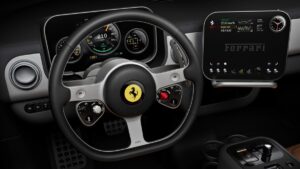




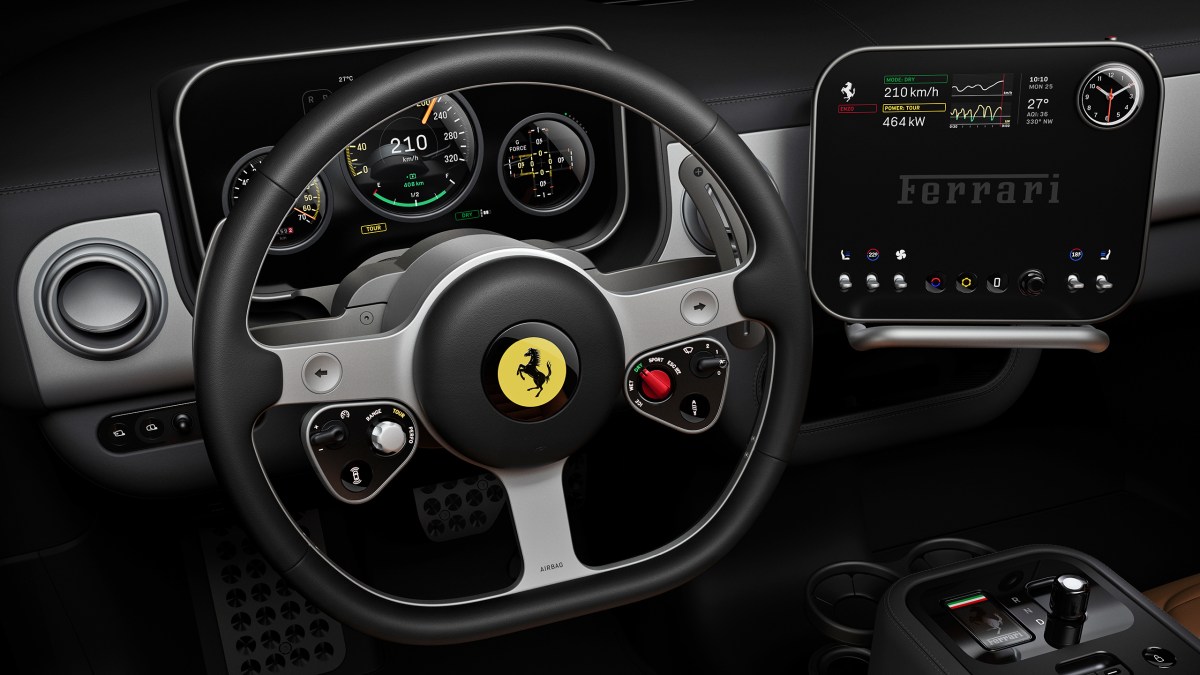
Back in February, Ferrari revealed details of its all-electric Luce. Billed as the Ferrari of the (now dubious) electrified future, the Luce’s design brief dipped heavily into the notion of embracing modern tech. But as it turns out, that’s not the only reason why Ferrari’s new electron-chugging four-seater will have more glass in the cockpit; the decision also saved Ferrari a boatload of money.
Don’t take it from us, though. You can hear it straight from Ferrari CEO Benedetto Vigna’s mouth thanks to this interview posted by the UK’s Autocar. In it, Vigna talks about India, free trade, and the shaky EV market. And now that the dust has settled from February’s big announcement, he’s acknowledging some not-so-pretty truths about modern car development, including the fact that all these touchscreens are being developed just as much to cut costs as they are to appeal to youthful buyers.
In fact, not only did Vigna join the growing chorus of automakers acknowledging that digital interface adoption is being driven primarily by cost (rather than customer demand), he went one step further by putting hard numbers to it: Touchscreens aren’t just marginally less costly than physical buttons, they’re a whopping 50% cheaper to produce.
Ferrari CEO Benedetto Vigna on Luce EV, impact of EU FTA on Ferrari prices & more | Autocar India

“Touch is something made by, for, the supplier advantage,” Vigna said in the interview. Making a touch button is cheaper, 50% cheaper….”
Remember, this is the crew that just paid Jonny Ive—easily the most recognized name in display design—to help engineer their infotainment and overall interior for the EV. If there’s a costlier way to design a touch-based system for a car, we’d be shocked. And yet, it was still substantially cheaper than it would have been to design and implement physical buttons and switches.
“If you have to make all these nice, beautiful, crafted buttons, you [need tooling],” Vigna explained.
Consistent touchscreen experiences are great for consumer electronics, Vigna acknowledged, but they don’t resonate with Ferrari’s customers.
“We need to do something unique,” Vigna said.
Going forward, Ferrari is aiming for what it calls good “phygital” design—physical controls with digital augmentations. There will be no pivot to an all-digital Ferrari cockpit.
In fact, Ferrari has already started walking back its cleaner designs in favor of more “interactive” cockpits, Vigna said. And it’s something we can expect more of it going forward.
Got a news tip? Let us know at tips@thedrive.com!
Read the full article here


