

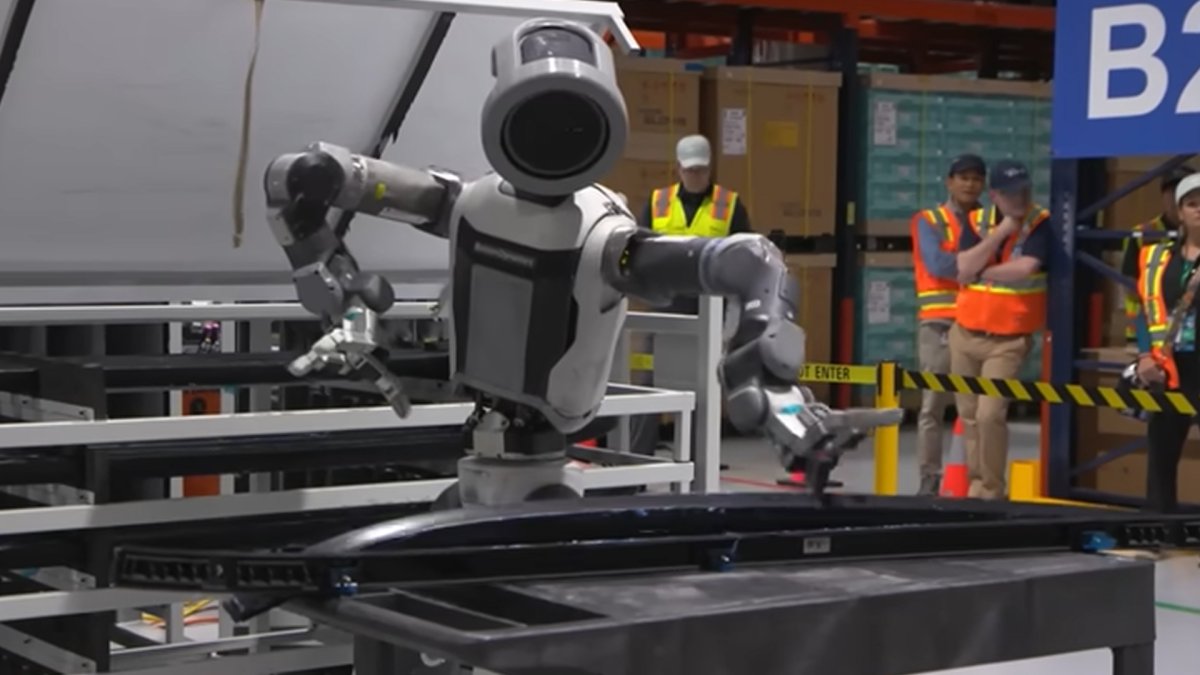
Way back during Covid (the longest five years ago), Hyundai spent a pretty penny to purchase Boston Dynamics—the company that has been teasing us with increasingly life-like (life-adjacent might be more accurate) robots for more than three decades now. Remember the robot dogs? Of course you do. They have humanoid models too. When the deal was first announced, it was on the heels of Hyundai floating some rather strange concept vehicles, but in the shorter term, the company is betting that walking robots might be better at building cars than being cars.
The concept isn’t new. Most assembly lines are highly automated and rely on a large, interconnected network of robots, but they bare little resemblance to most robot overlords of sci-fi infamy. They range from autonomous totes and shuttles to massive articulating arms that can do anything from welding frames, to inserting powertrain components, to painting body panels. You name it, and a robot is probably doing it.
But if you shrink that robot down, give it the ambulatory capabilities of a human and bathe the whole thing in AI, Hyundai reckons it can replace the most unreliable element of the modern assembly line: the human laborer. Enter Atlas, one of those humanoid ‘bots I mentioned up top there. As it turns out, Atlas can do more than dodge a hockey stick.
Progress made on AI-powered humanoid robots | 60 Minutes
In fact, Hyundai and Boston Dynamics have been training Atlas on various assembly-line tasks. Unlike the various highly-specialized machines already employed (so to speak) at the Hyundai’s “Metaplant” in Georgia, Atlas is far more flexible—more human, one might say. It can aid with assembly, parts sorting, and even inspection with the same adaptability as a human laborer, only without any of the fragility or unreliability associated with us mere fleshbags. If you’re in the manufacturing business, that’s all very appealing.
That said, neither company expects them to eliminate the need for a human workforce beyond menial, dangerous or strenuous workloads. And the production of robots itself will be a source of jobs too.
“These robots are not so autonomous that they don’t need to be managed,” Boston Dynamics CEO Steve Glaser told 60 Minutes. “They need to be built. They need to be trained. They need to be serviced.”
And if you’re concerned about immediate job losses, fret not. Hyundai says it will be “years” before even one Atlas robot is ready to take its spot on the assembly line full-time.
Got a news tip? Let us know at [email protected]!
Read the full article here