







Semi trucks are no different from other vehicles in that they produce tailpipe emissions that need to be dealt with. But while companies like Tesla are building electric semis, the need for supersized battery packs in order to deliver enough range while hauling makes electrification more challenging for big trucks than it is for passenger cars. A California-based startup has come up with an alternative solution, but it’s a weird one.
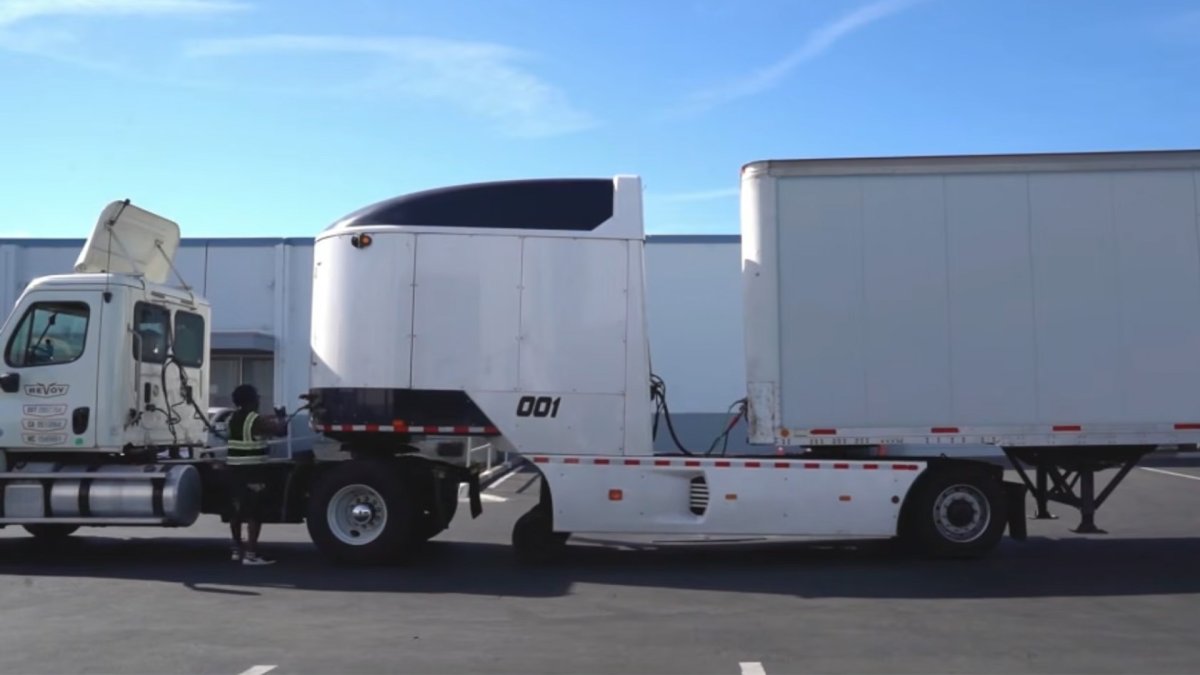
Founded in 2020, Revoy designed a module containing a battery pack and electric motor that sits between tractor and trailer, turning any semi truck into a temporary hybrid. It seems like a bit of a head scratcher to me, but Bloomberg reported this week that Revoy just completed a $27 million funding round, so some people clearly think it’s a good idea.
Revoy claims the current version of its battery booster has enough capacity for 200 miles of electric assist for an 80,000-pound truck. Instead of all-electric operation, it seems aimed more at improving fuel economy by taking some of the load off a truck’s diesel engine. The automated module is designed to add power in sync with the engine as it revs, and provide regenerative braking to help charge the battery when appropriate. But the pack is too big to be charged completely by regen, so Revoy also envisions a network of “hubs” where drivers can swap them, according to Bloomberg.
The detachable module can lower carbon emissions by up to 85%, Revoy estimates, and operating costs should be comparable to those of conventional diesel-powered trucks, even based on lower fuel prices from before the U.S. war with Iran, CEO Peter Reinhardt told Bloomberg. The startup also pitches its hardware as a way to extend the working lives of existing diesel trucks amid potential stricter emissions rules.
Revoy received approval from the National Highway Traffic Safety Administration (NHTSA) to use its equipment on public roads in 2023, and it launched a pilot program with Ryder the following year. The startup plans to begin commercial operations on a 200-mile route near Portland, Oregon, later this year using modules assembled from Chinese components and a specially trained corps of drivers. From there, Revoy hopes to use the money from its just-completed funding round to develop a less-expensive version with a smaller battery, but with similar range between recharges. That’s assuming Revoy sticks around.
It may rely on existing trucks, but Revoy’s solution still doesn’t solve the other major problem with battery-electric vehicles: the need for specialized infrastructure to support them. Wrangling all of these units could add significant cost and complexity. The current mood in Washington is also not favorable toward imported Chinese components, and while the $27 million is more than half the $41 million Revoy has raised so far, it’s just a drop in the bucket of the costs needed to engineer a replacement and ramp up homegrown production. All-electric semis are also about to get a boost in their most important market from a California rebate program that could weaken the business case for Revoy’s hybrid system.
Read the full article here


