

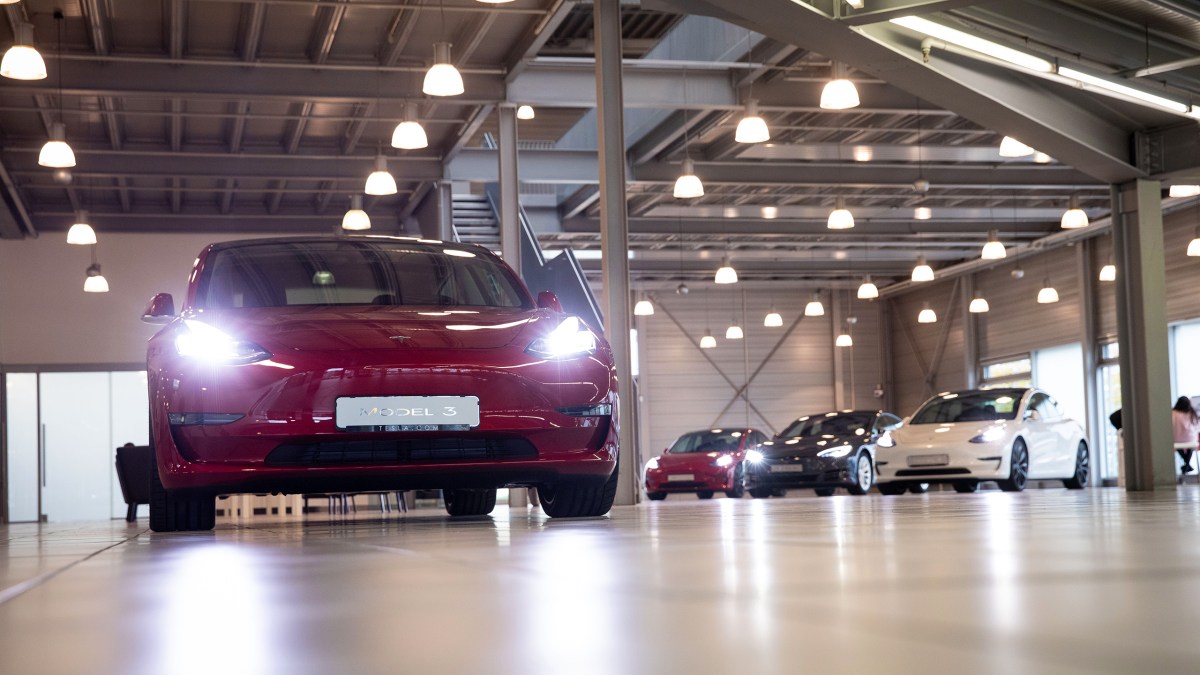
Back in the spring of 2024, Tesla notified the National Highway Traffic Safety Administration that the headlights on some 19,900 Model 3 and Model Y vehicles exceeded the maximum brightness allowed by law by nearly double in the most extreme cases. But rather than fix these blindingly bright EVs, the company logged a petition weeks later that it shouldn’t have to, because the defect was “inconsequential” to safety.
Well, it took two years, but the feds have responded to Tesla’s appeal with a resounding “nice try.”
The cars in question range from model years 2017 through 2023. Key to Tesla’s defense, as outlined in NHTSA’s own record of the petition, was that the headlights were too bright in specific zones, and that these zones were “positioned off the roadway both horizontally and vertically, keeping [them] outside of the driver’s or other road users’ natural line of vision.” The company also attempted to prove this with its own study, analyzing how the beam appears to an oncoming driver and determining that other motorists “would not experience glare or distraction from them.”
Another aspect of Tesla’s argument was that nobody had formally complained about these headlights leading up to the finding. Indeed, NHTSA had no such record of reports, let alone of harm or injuries. That is, at least until the administration opened the floor to public comment, at which point two individuals stepped forward. Besides, as the decision (which is embedded below) reads on Page 8, “The absence of complaints does not mean vehicle occupants have not experienced a safety issue, nor does it mean that there will not be safety issues in the future.”
But back to Tesla’s rationale for why these headlights aren’t a problem. Technically, they’re only too bright at specific angles that the automaker argues “fall outside the driver’s line of vision.” But, of course, a driver’s line of vision is always changing based on the environment they’re in. Approaching one of these Teslas on the other side of a steep grade, whether meeting at a peak or a valley, on a curve or straightaway, will eventually expose an angle or two that cause problems.
That’s also before you throw in the possibility of adverse conditions. “Certain weather conditions such as rain, snow, and fog could result in light from the noncompliant lamps causing veiling glare to the driver or other road users driving in the proximity of the vehicle having the noncompliant lamp(s),” the regulator explains.
So, Tesla wanted to sidestep this one and was swatted back. The company will have to notify all relevant owners and arrange for free repair or replacement of problematic components. And the EV maker isn’t the only manufacturer to fight this battle and lose.
Back in 2022, GM tried to make a similar case for a much larger group of vehicles—about 725,000 GMC Terrain SUVs, to be more precise. The headlights on those SUVs were even further beyond the brightness limit than Tesla’s (a detail you can be sure Tesla pointed out to the feds as part of its own petition), but GM unsuccessfully argued that the error was “inconsequential” all the same.
As someone whose struggles in sharing the road with LED-toting modern cars are well documented, I admit some bias here, but I’d also argue that I’m far from alone. As a Reuters report about Tesla’s failed petition quoted, a recent survey showed that 6 in 10 drivers in the U.S. agreed that “glare is a problem after dark,” and three-quarters of them believed the problem has gotten worse over the last 10 years.
Automakers will do what they can to avoid a recall and having to spend money or time fixing anything. What stings about cases like these, though, is the defense they share: that being blinded on the road is “inconsequential,” particularly at a time when more people than ever are speaking to the contrary.
Got a tip? Reach out to [email protected]
Read the full article here