






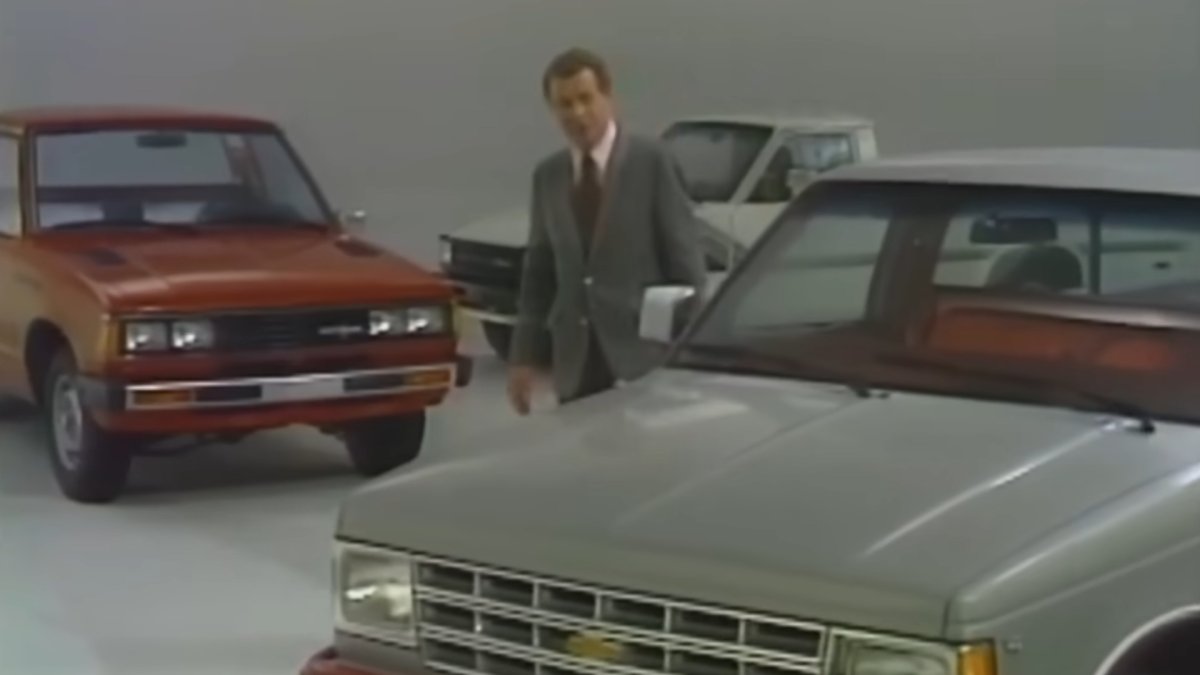
For a country that loves pickup trucks so much, our choices aren’t actually all that diverse. Full-size trucks are pretty much all alike, the midsize field is somewhat sparsely populated, and the compact segment is essentially just the Ford Maverick (RIP Hyundai Santa Cruz). Once upon a time, there were enough small pickups for sale in the U.S. for an entire enthusiast scene to form around them.
What happened? After all, America loves miniature things almost as much as it loves full-size things. Look no further than your local slider joint(s) for proof. There’s no one answer, Editor-in-Chief Kyle Cheromcha explains, but there’s one thing we can pretty much universally agree on: it’s not strictly the fault of truck buyers.
Our first culprit? The good old Chicken Tax. If you want to make an American automotive executive squirm, ask them about this piece of policy dating back sixty years.
It was a tariff instituted to protect American manufacturers from being undercut by cheap trucks from Volkswagen, which was making unexpected inroads into the U.S. market in the 1960s. It didn’t really work, thanks to something called the “chassis cab” loophole, which allowed vehicles to be imported without their cargo boxes attached. Since the final assembly took place here, they weren’t subject to the additional import duties.
This led to a flood of small clones of internationally built trucks being sold under both domestic and import nameplates in the 1960s and early 1970s. Eventually, Toyota and Nissan established manufacturing bases here in the United States, and by the 1980s, they were looking for ways to pivot from gaining a basic foothold to building the sorts of trucks Americans bought from Detroit. By the 1990s, both were offering midsize body-on frame pickups (including the Tundra, which was a bit small despite aiming itself at larger U.S. offerings); by the 2000s, both had expanded into the true half-ton space.
The aughts turned out to be pivotal for the future of small trucks. With Japanese automakers establishing even larger manufacturing footprints in the U.S. and pivoting to larger, more profitable (and yes, more popular) models, the entire segment shifted away from truly compact pickups. The Great Recession of 2008 and simultaneous CAFE overhaul helped shape the market we have today.
In the immediate aftermath of 2008, we saw not only the introduction of a stricture emissions regimen, but the restructuring of the way fleet-wide fuel economy is calculated by the EPA. It was called the “footprint model.” It’s a complicated formula that classifies cars by several different factors, including physical dimensions, tire size and, and track width.
The exact math isn’t as important as the effect it had on the truck market. Rather than classifying vehicles by their form and purpose, the new rule instead cared more about the size of their shadow. The smaller the car, the loftier the fuel economy targets.
It makes sense to a degree. A small car should be efficient; a larger one is expected to be less so. But if you zoom out a bit, you can see that this actually creates an incentive for automakers to build larger vehicles. The bigger they are, the less efficient they have to be. Bigger cars can have bigger engines; bigger engines can move bigger cars; bigger cars command larger profit margins. Coupled with the economic recover (such as it is) of the past decade and a half, this feedback loop has proved foundational to the seemingly irreversible passenger-car bloat we’ve seen over that same period.
It’s also a big contributor to our lack of small trucks, and helps explain how the Ford Maverick and Santa Cruz came to be. Not only were they build on exist compact platforms with proven, efficient small engines, but their larger dimensions meant that it was OK for them to be less efficient than the sedan, hatchback and crossover sibling built on the same fundamental architectures—and the Maverick still needed a hybrid to guarantee it could meet future targets.
Want further evidence? The footprint model went into effect in 2010. Ask your favorite digital encyclopedia when the Ford Ranger, Ford Explorer SportTrac and Dodge Dakota were canceled. Coincidences, all? Nah.
Until recently, the 40-plus-mpg targets for the smallest light trucks have kept it too cost-prohibitive to build here, especially for import manufacturers who would also be subject to the Chicken Tax. While the latter is still the case (tariff barriers have actually grown for some manufacturers in recent years), the former is (at least for the moment) a non-factor. Under the current administration, CAFE is about as enforceable as the Pirate’s Code, and the EPA is currently reverting to an older, more conservative timeline for U.S. emissions and fuel efficiency targets.
Could EV be the next move for small trucks? Ford seems to think so. Ram, meanwhile, appears poised to take advantage of the current gaps in CAFE enforcement to bring the Rampage here before the end of the decade.
Now, if we could just get rid of that Chicken Tax…
Got a news tip? Let us know at tips@thedrive.com!
Read the full article here


