

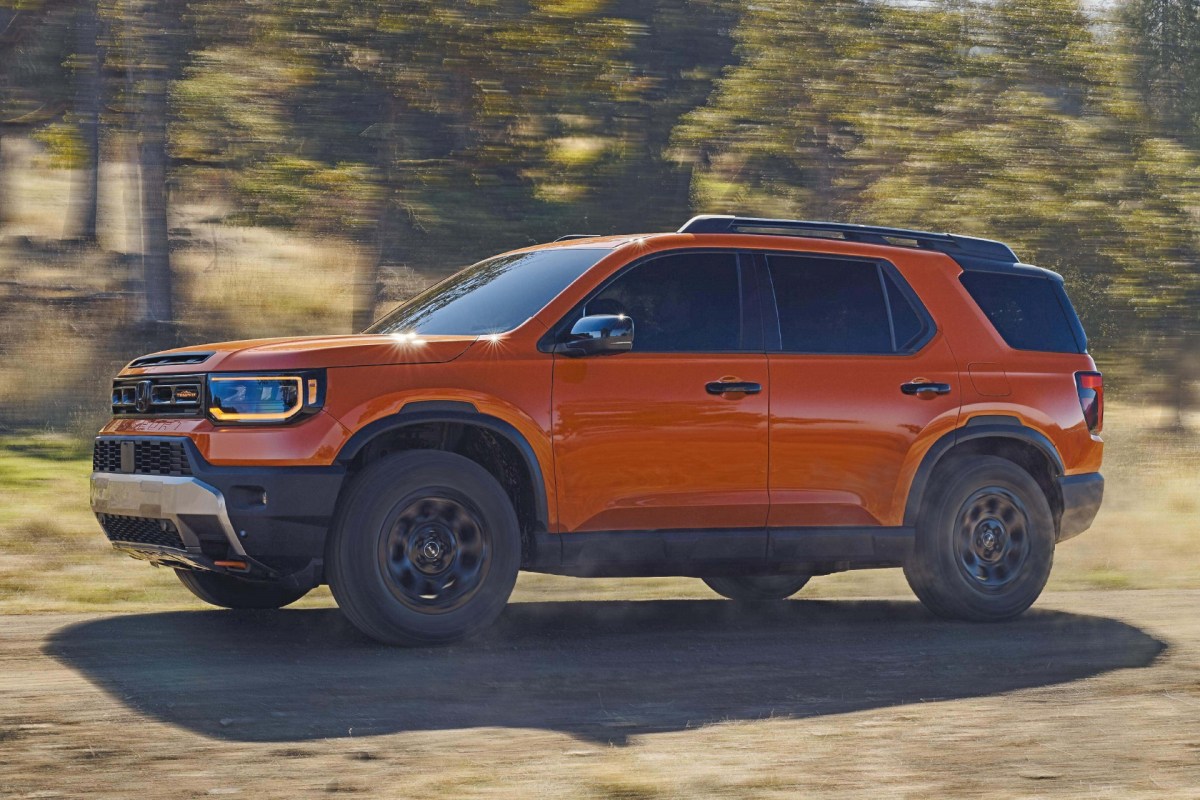
This week, the Trump administration announced sweeping changes to America’s emissions regulations. Judging by how it’s being received, you might imagine it paves the way for gas guzzlers to further strengthen their grasp on the U.S. automotive market. But there’s actually a pretty wicked twist: The new rules would effectively eliminate the Corporate Average Fuel Economy (CAFE) “light truck” loophole, paving the way for a new system that more accurately classifies passenger cars and utility vehicles.
If you’re not familiar with the current state of U.S. emissions regulations, frankly, it’s a hot mess cobbled together from rules established half a century ago. Over the decades, that patchwork of rules became less and less effective—to the point where it works against manufacturers who would otherwise be able to build smaller, more efficient trucks.
This happened because automakers found ways to exploit the “light truck” classification, which, 50 years ago, was meant to provide relief for those who had no choice but to drive a truck or SUV. By the 1975 rules, any vehicle that met the following criteria was automatically classified as a “light truck,” and thus subjected to less stringent CAFE standards:
- Transport more than 10 persons.
- Provide temporary living quarters.
- Transport property on an open bed.
- Provide, as sold to the first retail purchaser, greater cargo-carrying than passenger-carrying volume.
- Has either 4WD or a GVWR of more than 6000 lbs., and meets all four of the following criteria:
- Approach angle of not less than 28 degrees
- Breakover angle of not less than 14 degrees
- Departure angle of not less than 20 degrees
- Running clearance of not less than 20 centimeters (7.87 inches)
According to NHTSA, those guidelines may have cut the mustard in 1975, when they functioned as an adequate catch-all for commercial (or private, non-passenger) use; that’s simply no longer the case.
“The agency opted to omit vehicles that qualified via these alternative non-passenger pathways because their designs contained other non-passenger characteristics or off-highway features that could skew the results of an analysis intended to evaluate whether a vehicle was designed chiefly for enhanced property-transporting utility,” NHTSA’s report said.
If you’re a fan of factory off-road trucks, those figures may be familiar. That’s no accident; automakers have exploited this loophole for decades. But under the new rules slated to take effect in 2030, NHTSA is doing away with those fiddly numbers and replacing them with a single new measurement, dubbed “Light Duty Work Factor,” or LDWF, which is the simple sum of its towing and payload capacities.
Beginning with the 2030 model year, a vehicle will qualify as a non-passenger automobile (light truck) if its calculated LDWF is greater than or equal to 8,500 pounds. This new formula uses the Gross Vehicle Weight Rating only to determine payload capacity; beyond that, it’s irrelevant. Under the new rules, size doesn’t matter.
“This new performance-based utility attribute […] would be determined based on a light-duty vehicle’s ability to transport property via its payload and towing capacities,” NHTSA’s report said. “Performance-based standards preclude design or technology obsolescence by only prescribing a target without guidance or restriction on how it should be achieved.”
In simple terms, if a vehicle’s primary purpose is to carry passengers, it will be judged as a car. If its primary purpose is to carry cargo or perform other utility functions, it will be judged as a light truck.
These changes won’t impact today’s biggest trucks and SUVs, which will easily meet the LDWF threshold (many on towing capacity alone), but it could have significant ramifications for the midsize crossover/SUV segment, where many vehicles can tow reasonably large trailers despite modest payload capacities.
The classification changes will be accompanied by eased emissions requirements for light trucks. That may sound like a regression, but keep in mind that the category will be much smaller and will no longer include more fuel-efficient crossovers. For now, these ‘tweeners are being evaluated as light trucks. Under the new rules, they’d be evaluated as passenger vehicles and penalized more heavily for their lower efficiency—at least in theory. Right now, CAFE’s enforcement mechanism is toothless.
And while these changes are being framed as just a small part of a much larger regulatory rollback designed to ease requirements for automakers (who would then pass those savings on to consumers), they won’t have much near-term impact. Ram’s decision to drop auto-stop/start and its mild hybrid setup, for instance, is about as significant a change as we can expect to see for the foreseeable future. If and when the EPA gets its teeth back, things will get weird fast.
Got a story tip? Let us know at [email protected]
Read the full article here