

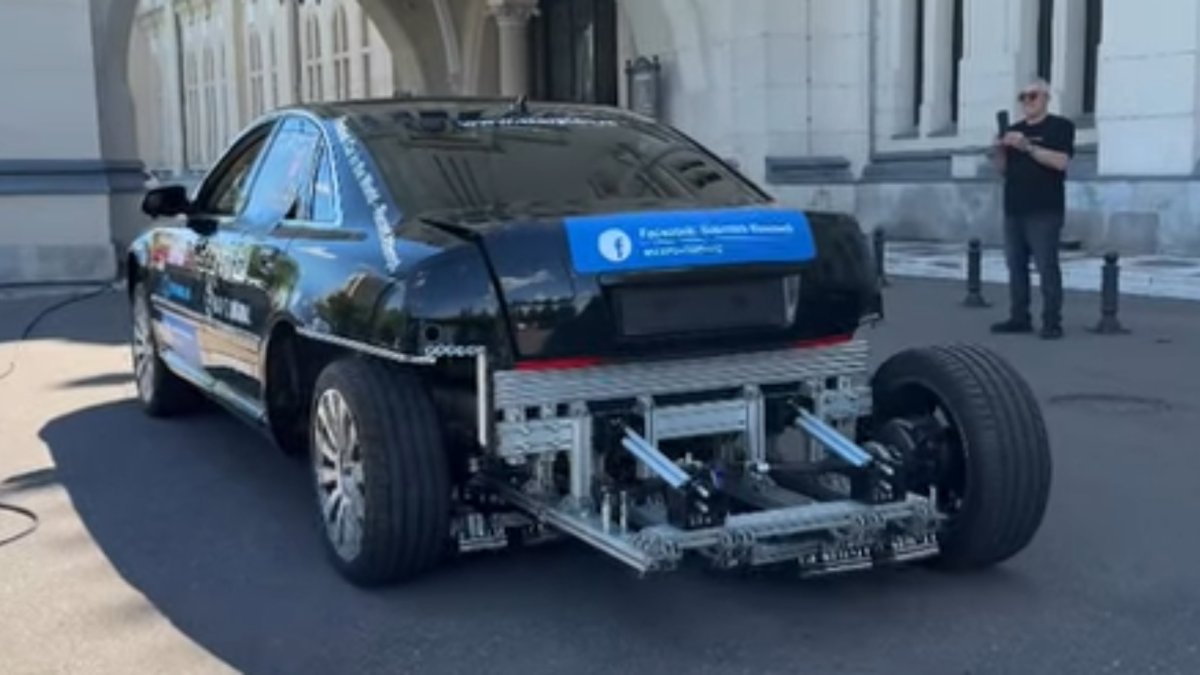
Remember those spring-loaded toy cars that you’d pull back to release? Did you ever sit around as a seven-year-old wondering why adults messed around with gasoline or diesel when clearly all you had to do was pull the car back far enough and it could easily travel long distances using no fuel at all? No? Just me and Adrian Roșca of Rosmar H? Cool. Cool, cool, cool.
OK, I’m no engineer, and this Audi prototype isn’t using steel springs, but rather compressed air. Yep, the mythical air-powered car. But I’ve heard that pitch once or twice. It always seems to fun afoul of that pesky first law of thermodynamics. It can’t work… right?
Rosmar H disagrees, and has even filed for (and been awarded, somehow? It’s not exactly clear) a patent for “a motor vehicle and to a method for moving the same when blocked/stuck on a surface covered with e.g. mud, snow, ice, sand or when it is supposed to run up or down a surface of a slope of more than 45°.”
OK, so you wanted to make a better alternative to all-wheel drive. I’m down. So what in the Mighty Morphin’ Power Rangers is this thing?
In the process of trying to reinvent the way cars achieve and maintain traction, Rosmar H may have lost its own grip on reality. The company’s description of its (again, maybe patented) technology could charitably be described as “high-altitude,” but the basic idea seems to be that a car could be propelled using nothing but compressed air being released sequentially from giant, longitudinal pistons that essentially pull the car down the road. Theoretically, the car’s inertia could also be used to recuperate energy on the return stroke, much the way regenerative braking uses deceleration to recharge a hybrid or EV battery.
Based on the translated patent info from above, Rosmar H came about this tech from a relatively novel perspective: If the biggest obstacle to getting un-stuck from a low-traction environment is a moving tire, then stop trying to move the tire and move the car instead. That brief led them to this pneumatic monstrosity that does at least move under its own power. How well this translates to a real-world use, however, remains a bit unclear.
14 ianuarie 2026
As we established above, it seems to be recapturing kinetic energy from the car’s momentum to “charge” its main air tank with each return stroke, but every time it does, it’s sacrificing forward velocity in the process. If you’re at all familiar with the notion of parasitic losses, you know that every time you need to convert one type of motion to another, some of it is lost and can’t be recovered.
Where does the initial energy to get the car moving come from? Well, there’s no battery, no engine, and no mention of angel tears or unicorn flatulence, which leaves only one likely possibility: Thin air.
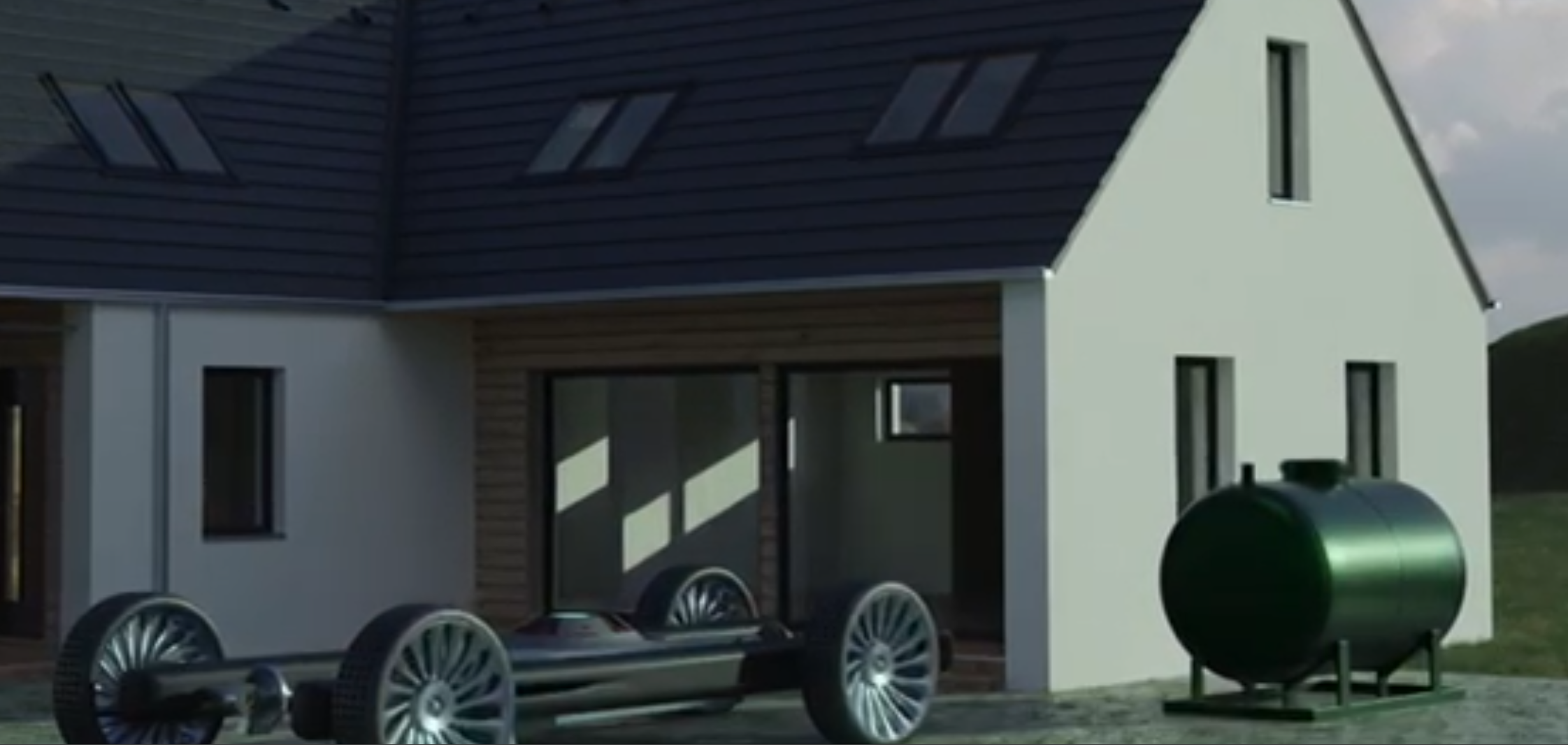
Yes, that was a joke, but it it also appears to be accurate. The car may not have a battery, but it has a kinetic energy reserve in the form that compressed air tank. You can see it on this scale model the company uses as a demo. This reserve in this tank would then be supplemented by energy recovered from the driveline. Like an EV, it’s something you could top off at home using an adequate compressed air source (as suggested by the screenshot above). There’s a clearer view in this acceleration demo. They say the real thing should do 0-60 in 0.3 seconds.
The question, of course, is just how much energy you can store in a compressed air tank. Well, here’s some back-of-the-napkin math: A 25- gallon tank holding air compressed to what Google suggests is a typical room-temperature storage pressure (2,000 psi) contains between 0.65-1.3 kilowatt hours of potential energy (depending on how it’s released, but we’re not here for a chemistry lesson)—or roughly the capacity of a small, old-fashioned hybrid battery.
For comparison’s sake, the GM Hummer EV’s battery has a usable capacity of about 170 kWh. Again, I’m not an engineer, but that seems like… less?
Got a news tip? Let us know at [email protected]!
Read the full article here